Industries
Healthcare & medtech
Patient portals, clinic systems, medical imaging pipelines and research tooling — with privacy, traceability and clinical review built in.
What are the typical challenges in healthcare and medtech software?
Healthcare software carries the strictest data regime of any vertical and the oldest integration surface. Health data is a special category under GDPR Article 9 (Regulation (EU) 2016/679), and a breach is expensive: IBM’s Cost of a Data Breach Report (2024) put the healthcare average at roughly $9.8 million, the highest of any industry for the fourteenth year running. On the other side sit hospital and clinic systems without APIs, imaging and lab volumes that outgrow manual review, and research code that never becomes a product.
- Sensitive data under GDPR/HIPAA-grade requirements
- Legacy clinic systems with no APIs
- Imaging and lab data volumes that overwhelm manual review
- Research code that never becomes a product
What do we build for healthcare and medtech?
We build patient and doctor portals, appointment and telemedicine platforms, integrations with HIS/LIS and insurance systems over HL7 v2 and FHIR, imaging and data pipelines for research and clinical teams, and mobile apps for patients and field staff. FHIR R4 (HL7, 2019) is our default exchange format; where a legacy system only speaks HL7 v2 or CSV exports, we put an adapter in front of it rather than rewrite the core. Software that qualifies as a medical device is built to the documentation and lifecycle expectations of the EU MDR (Regulation (EU) 2017/745) together with your regulatory lead.
- Patient and doctor portals, appointment and telemedicine platforms
- Integrations with HIS/LIS, HL7/FHIR, insurance systems
- Imaging and data pipelines for research and clinical teams
- Mobile apps for patients and field staff
Where does AI move the numbers in healthcare?
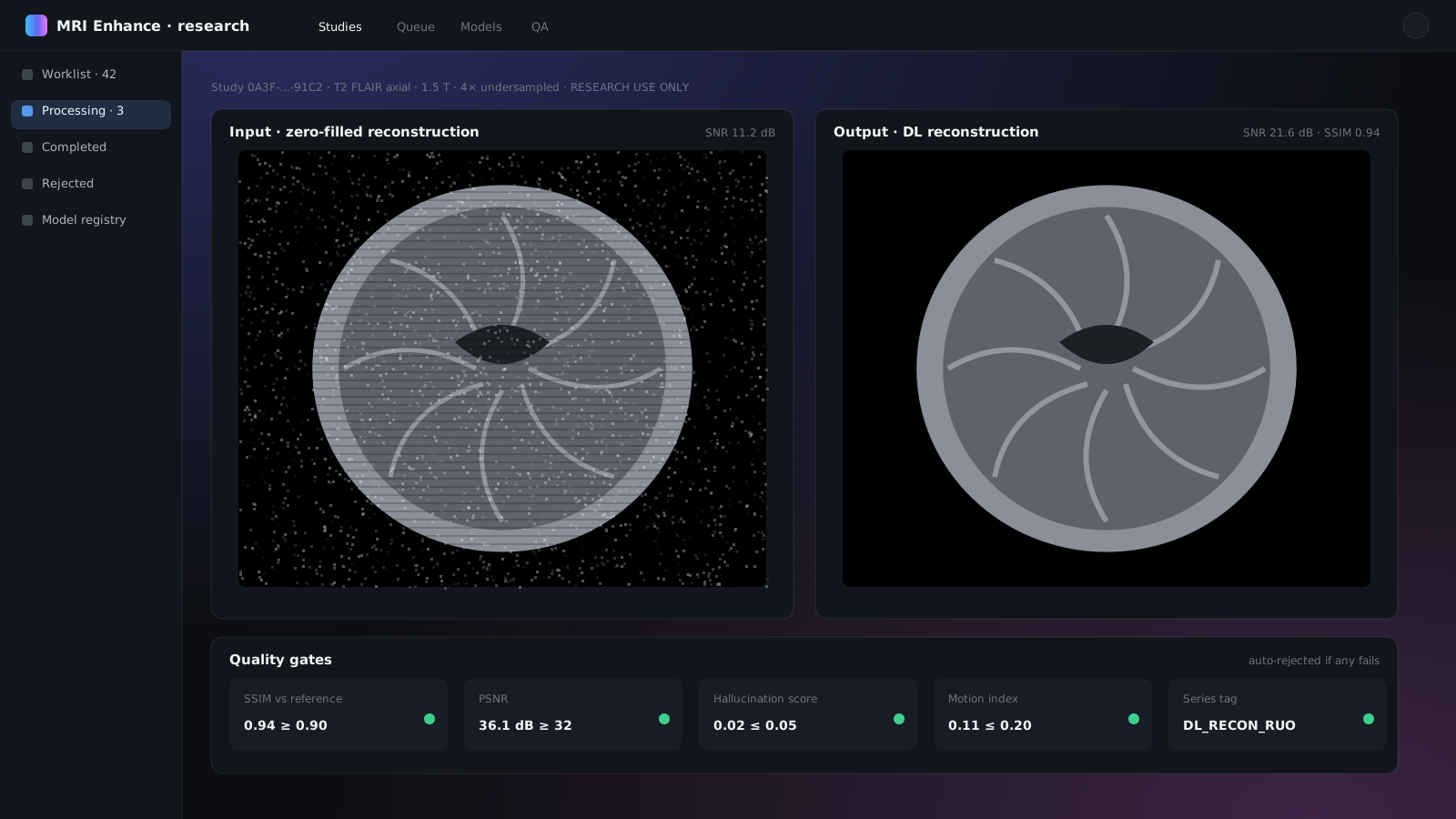
AI moves numbers in healthcare where data volume exceeds clinician time: image reconstruction and analysis, document processing, triage of support requests and operational forecasting. The WHO Global Strategy on Digital Health 2020–2025 (WHO, 2021) frames digital tools as a route to universal health coverage, but every clinical use needs evidence and oversight. The EU AI Act (2024) treats AI that is a safety component of a medical device as high-risk, and the European Health Data Space (Regulation (EU) 2025/327) sets new rules for secondary use of health data. Our medical imaging case shows the pattern: research model, reproducible pipeline, clinician review at every stage.
- Deep-learning reconstruction and analysis of medical images (research use)
- Document AI for referrals, reports and claims
- Triage and routing assistants for support lines
- Forecasting of load, no-shows and inventory
On-premises vs cloud for patient data: which do you need?
The direct answer: cloud is acceptable for health data when residency, encryption and processor contracts are handled explicitly; on-premises is still the pragmatic choice where a hospital’s policy, a national rule or an existing data centre dictates it. Most projects end up hybrid, with imaging and research pipelines on-premises or in a sovereign region and portals in the cloud.
| Criterion | On-premises | Cloud (EU region) |
|---|---|---|
| Data residency | Fully controlled | Region-pinned; verify sub-processors |
| GDPR Art. 28 processor terms | Not needed for hosting | Required with the provider |
| Scaling for imaging workloads | Bounded by hardware | Elastic GPU, pay per use |
| Operations burden | Your team patches and backs up | Managed services, shared responsibility |
| Time to launch a portal | Weeks to months | Days to weeks |
Why Glanit for healthcare?
Because we have already taken a research model to a reproducible clinical pipeline, and because everything we build for healthcare is logged, versioned and reviewable by clinicians. Sixteen years and 500+ projects have taught us to treat every legacy HIS as an integration risk and every model output as a claim that needs evidence. We design data minimisation, retention and access control to GDPR from discovery, and we work alongside your regulatory and clinical leads rather than around them. Security verification is available under security services.